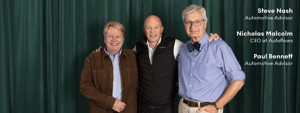
AI is not the Strategy. Closing the Retention Gap in Automotive Aftersales is.
A conversation with Paul Bennett and Steve Nash, hosted by Nicholas Malcolm
Watch the whole podcast episode.
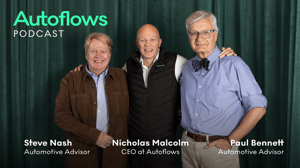
There's a moment early in this conversation where Steve Nash - who spent 15 years as Group Aftersales Director at BMW UK and now leads the Institute of the Motor Industry - says something that could serve as the thesis for the entire discussion:
"Everybody has a plan until they get a punch in the mouth."
He's borrowing from Mike Tyson, but he's talking about dealership operations. Workshop loading schedules that look perfect on a whiteboard and fall apart the moment a technician calls in sick. Retention strategies that work in theory and evaporate at the front counter. Plans that don't survive contact with the actual, messy, human reality of running a dealership.
That tension - between the plan and the punch in the mouth - runs through everything Paul Bennett and Steve Nash discuss in this episode. Paul brings 40+ years in automotive systems, data, and customer retention, most recently building SaaS technology for auto finance companies. Steve brings 15 years running BMW UK's aftersales operation and over a decade leading the UK's leading professional body for the motor industry. Together, they've seen this industry's profitability problem from every angle — and they don't think AI is what solves it.
Here's what they had to say.
The Profitability Crisis Nobody Wants to Name
For most of the last 50 years, new car sales carried the dealership. Aftersales was an afterthought - necessary, but never the main event.
That math has broken down. As Steve puts it, dealers today - even good ones - are "struggling to make much more than a one or 2% return" on new car sales. Paul agrees: "The after sales world has been well known for many, many years that car dealerships - the sales through of new and used vehicles - covers all the fixed costs and overheads of running the business. And the after sales department was the main profit driver."
The result is a European-wide profitability crisis, and aftersales has finally - belatedly - landed in the spotlight it always deserved.
But here's the trap, according to both guests: dealers are responding to this crisis by reaching for AI as if it's the fix. It isn't.
AI Is Not the Strategy - Closing the Retention Gap Is
Paul Bennett has a phrase for this: "We sell the steak, not the sizzle."
"Everybody's selling sizzle and AI is this, and AI is that. Yes, it's important when taken in context. And if you've got a poor engine room with low quality data, the AI aspect will not give you the results that you're looking for."
The "engine room" - clean, connected, accurate customer data - is the steak. AI is the sizzle on top. And you can't season your way out of a bad cut of meat.
Steve Nash frames the same idea from a different angle, and this is the line the whole series is built around:
"AI is not the strategy. Closing the retention gap is a strategy. The profitability is in the aftermarket. There's not a profitability gap in AI."
The Retention Gap is the term we're using throughout this series for the actual problem: the distance between the customers a dealership thinks it understands and the customers it actually understands. Every dealer believes their database is roughly fine. Steve's experience says otherwise:
"I don't think you ever got anybody say, my database is rubbish... but I think even the ones who believe their data is spot on and they employ people to look after it and all the rest of it, in reality, if you really, really critically analysed it, there would be gaps."
That gap isn't a technology problem you can automate your way past. It's a foundation problem - and no AI layer fixes a foundation it's built on top of.
Data Foundations: What It Actually Means to Trust Your AI
If the engine room comes first, what does a functioning one look like?
Steve is blunt about the prerequisite: "There's no system in the world that is going to give you the right answer if you don't have the right data for that answer to be based on." Deep integration with the DMS isn't optional - it's the floor.
Paul brings this down to something concrete: personalization. Not personalization as a marketing buzzword, but as a mechanical fact about how the system behaves.
"If you've got a mechanism or a process that can be linked intelligently to your wider, broader database, that will know that my phone number is linked to my name, my name is linked to these two vehicles, which are currently on their schedule... it makes the whole thing smooth and makes things flow, and it just makes people easier to deal with."
Get this wrong, and the failure shows up exactly where customers notice it most - the moment of truth Steve calls out with a wince-inducing example: quote a customer £250, hand them a £500 bill. That's not an AI failure. That's a data failure wearing an AI costume, and it's the fastest way to lose a customer's trust permanently.
The two of them keep circling back to one idea: CRM isn't a system you bolt on. It's a definable outcome. As Steve puts it, "the best thing in the world is to have a cookie cutter process that doesn't look like one."
The Retention Gap, Defined
So what does the gap actually consist of, in practice?
Steve's answer is direct: "The gap is there because you don't understand - you don't know your customers as well as you think you do." Knowing when someone's next service is due isn't customer understanding. It's a calendar entry. Real understanding means knowing what else that customer needs - and offering it before they go looking for it elsewhere.
He tells the story of the best dealership he ever worked with, where sales staff would step in on reception during busy periods and end up generating new car leads from aftersales customers - because everyone in the building understood the customer end-to-end, not just their own slice of the process.
His advice for dealers is almost tactical in its bluntness: "Be really, really selfish with your customers. Don't ever let them walk away." If a customer can get a better tyre price at the local fast-fit centre, match it - because losing them over a tyre costs far more than the margin you protected.
Paul's version of the same principle, distilled: "Never speak to customers if you haven't got something of value to share with them. Never." Right message, right time, real value - every time, or don't bother reaching out at all.
How Autoflows Closes the Gap
This is, not coincidentally, the exact problem Autoflows was built to solve. Where a lot of aftersales technology gets bolted onto the DMS as one more disconnected tool, Autoflows is built as an aftersales automation platform - deeply integrated with the DMS from day one, so the "engine room" Paul describes is the starting point, not an afterthought.
The AI layer sits on top of that. In practice, that's meant dealerships using Autoflows' outbound Voice AI to follow up on missed contacts reaching roughly 35% of customers who'd otherwise have gone quiet - with around 40% of those going on to book. That's not AI replacing the service advisor. It's AI doing the 24/7 follow-up Steve says no human team can sustain, so the people on the front line spend their time on the moments that actually need a person.
Advice for the Next Generation in Automotive
One of the more human moments in the conversation comes when Nicholas asks whether young people entering the industry can actually build a career starting in aftersales - a department that's historically been seen as the fallback, not the destination.
Steve's answer draws on his own career and the people he's developed: "Only recently was out in China speaking to the CEO of BMW China... I started at the office as an apprentice." Aftersales, he argues, has quietly been one of the best entry points into the industry for decades - most people just don't realize it because the department has never had the glamour of sales or marketing.
Paul's caveat is a challenge to leadership, not to newcomers: too many dealerships "don't start with the end in mind." They hire for a role, not a career. Fix that, he argues, and aftersales becomes a genuine talent pipeline rather than a holding pen.
Both single out the service advisor role for particular respect - and particular concern. Steve calls it "the point of the spear" - high-pressure, customer-facing, and too often loaded with admin work that has nothing to do with what makes someone good at the job. Strip that away, give people the right support, and - in Steve's words - "their job becomes better and easier and more enjoyable... it's easier to attract people into those roles."
Designing the Dealership of the Future
The conversation closes with a genuinely fun thought experiment: if you built a dealership from scratch tomorrow, with no legacy assumptions, what would it look like?
Steve's answer is about allocation, not architecture: "You would have a very clear idea of what, where people add the greatest value and where processes and automation adds the greatest value... if you get that balance absolutely right, you are likely to maximise your result."
Paul goes further, describing a model that already exists in parts of the UK and, more fully, across China: "Bring a car buying or shopping experience into the mainstream... after all a dealership is a shop, and you go shopping for a car." He describes UK retailers that placed EVs inside shopping centres - no salespeople, just advisors, full configuration on-site, purchase completed from home later. "If you can give people an Apple store experience when they're looking to buy their car, you've cracked it."
Steve confirms it's not hypothetical: "That's pretty much what you see in China... at least in the cities. You go into the shopping mall and there is a Xiaomi store there, or a NIO store, or Zeekr, or whatever it may be - because it's where people are."
The Benchmark That Never Goes Out of Date
For all the talk of AI, data, and automation, the episode ends on something refreshingly analog. Nicholas's closing challenge to any CEO or board member evaluating their own dealership: don't fly to San Francisco for the latest AI conference. Go down to your own dealership and call it like a customer would.
Paul's closing line sums up the whole conversation better than any framework could:
"There's too much lip service paid to customer first, customer centric. You've got to believe it. You've gotta breathe it. You've got to absolutely let it exude from the pores of your body."
AI can help you execute that belief consistently, at scale, without a day off. It cannot manufacture the belief itself. That's still the job of the people running the dealership - and, according to two people who've spent a combined six decades doing exactly that, it always will be.
If you want to see where your own dealership's retention gap actually sits, get a intro - we'll show you the number, not just the theory.